Friday, January 30, 2009

Obama team's finances hard to access

Even as President Barack Obama issued new rules to make government more open and transparent, his administration is relying on an antiquated and opaque disclosure system.

Anyone seeking copies of the financial disclosure reports recently filed by members of his Cabinet and his top aides has to navigate an arcane and intrusive bureaucracy reliant on faxes, dense government forms, snail mail, or proximity to Washington, plus an insider's knowledge of an unpredictable schedule dictated by a host of government officials.

Simply put, it’s a system that seems to run counter to Obama’s talk and his new rules about using technology to open the halls of the federal government to the public.

To be sure, the process for filing and releasing disclosure reports is a legacy that Obama has inherited from previous administrations – and one not easily changed in the first days of the new administration.

But it’s one that he could bring into the 21st century on his own – without congressional action – by executive order, which he was urged to do in post-election meetings that his team arranged with advocates for heightened government disclosure.

It’s especially anachronistic for financial disclosure forms – which are intended to ensure government employees’ economic interests do not conflict with their officials duties – to be so difficult to get, said Massie Ritsch, spokesman for the Center for Responsive Politics.

The non-partisan government watchdog group recommended the new president tighten reporting requirements, make the disclosure forms electronic and searchable and put them online quickly.

“If you’re going to use technology and transparency to raise the ethical bar, you simply can’t allow these forms to be filed and stored on paper and kept in a single office in Washington,” said Ritsch. “In this day and age, publicly available means online. Any form that the government collects should be available electronically.”

“It’s not just for reporters,” he added. “There are activists who want these forms, watchdog groups, individual citizens who care that the people being appointed to high government positions aren’t in it for personal gain.”

White House aides would not say whether Obama planned to heed the advice from the center and other transparency advocates. But Obama transition adviser D. Scott Martinez, who met with Ritsch’s group and others, suggested that a memorandum Obama issued on his first full day in office to all agency and department heads should compel the agency that handles presidential appointees’ disclosures, the Office of Government Ethics, to post the forms online within 120 days.

“Executive departments and agencies should harness new technologies to put information about their operations and decisions online and readily available to the public,” reads the memorandum. “My administration will take appropriate action, consistent with law and policy, to disclose information rapidly in forms that the public can readily find and use.”

Obama’s aides declined to say whether the memorandum or an accompanying executive order would compel the Office of Government Ethics to post financial disclosure reports online. And officials at the ethics office would not answer questions about whether they intend to.

But Martinez, an election lawyer, pointed out that the disclosures “are public documents” and that the memorandum should be considered an order “to all executive departments, including the Office of Government Ethics, so I would expect that all departments would comply” before the 120-day deadline.

The first batch of personal financial disclosures – including such high-interest appointees as Secretary of State Hillary Clinton, Treasury Secretary Timothy Geithner and Deputy Defense Secretary-designate William Lynn– were not made easily and quickly accessible to the public because of a number of impediments.

First, it’s tough to know when the disclosures for any given appointee will be publicly available. For example, Clinton’s form, which revealed that her husband earned more than $2 million from foreign sources after she entered discussions about becoming secretary of state, had been cleared by the office for more than three weeks before Politico and the Associated Press acquired it.

The disclosures’ releases can be delayed by thorough, and sometimes lengthy, reviews for potential conflicts of interest by lawyers at the White House and – in the case of Cabinet members – their agencies, which must certify them. Then, a 30-day countdown starts toward their required release by the Office of Government Ethics.

But they’re still not public at that point. Rather, the office then conducts its own review, certifies the forms and has another 30 days to make them available to the public, though it’s been moving more quickly during the transition and has tried to make things easier by listing available disclosures on its website.

Even then, in order to actually obtain the disclosures, requestors have to print and fill out a form posted on the office’s website. It asks which disclosures are being requested and the requestor’s name, address, phone number, occupation and signature – information the form says can be passed along to law enforcement, congressional offices or private contractors working for the federal government.

Completed forms then have to be faxed to the office. They can’t be e-mailed. And requests for disclosures of officials whose last names begin with “A” through “L” go to one employee, while requests for disclosures of officials whose last names begin with “M” through “Z” go to another.

The two are now deluged with media requests for incoming officials’ disclosures.

But on Tuesday when Politico requested the forms, the employees were able to make quick work of a request for the 30-plus disclosures that had been filed at that point, quickly producing a set of photocopies of the forms.

They’re not scanned or recorded electronically, though, so requestors have to make arrangements to have the forms mailed or picked up at the agency’s office, where a receptionist dispenses the disclosures after yet another signature – this one on a carbon-paper copy of the original form.

And, to get other technically public disclosure documents such as appointees’ ethics agreements and waivers, requestors have to use different forms and may have to deal with other agencies and their request procedures.

Obama slams Wall Street for rich executive bonuses

WASHINGTON – President Barack Obama, who has ordered a pay freeze on six-figure White House aides, wants to talk to Wall Street executives about a report indicating payments of over $18 billion in bonuses as the economy was in virtual free fall.

"It is shameful," Obama said from the Oval Office Thursday. "And part of what we're going to need is for the folks on Wall Street who are asking for help to show some restraint, and show some discipline, and show some sense of responsibility."

The president's comments, made with new Treasury Secretary Timothy Geithner at his side, came in swift response to a New York state comptroller's report saying that employees of the New York financial world garnered an estimated $18.4 billion in bonuses last year.

Obama's harsh criticism of Wall Street came just one day after he brought several well-paid chief executives to the White House and praised them for being on the "front lines in seeing the enormous problems in our economy right now."

By sunset Thursday, he was serving notice that both he and Geithner will speak directly to Wall Street leaders about government bailouts, extravagant executive perks and a public revulsion over a perceived me-first attitude in executive suites.

The corporate leaders who appeared with Obama Wednesday are not from the Wall Street financial companies that the president targeted, but rather are the heads of such well-known manufacturing and technology giants as IBM, Motorola, Xerox and Corning. Still, they get paid handsomely.

Most of those who stood with Obama earned a total 2007 compensation package of between $8 million and $21 million, according to a review by The Associated Press. Those calculations include the executives' salary, bonus pay, incentives, perks, the estimated value of stock holdings and other compensation.

Obama called the payment of the Wall Street bonuses "the height of irresponsibility," and said the public dislikes the idea of helping the financial sector dig out of a hole, only to see it get bigger because of lavish spending. The comptroller's report found such bonuses were down 44 percent, but at about the same level they were during the boom time of 2004.

Vice President Joe Biden spoke even more bluntly.

"I'd like to throw these guys in the brig," Biden said in an interview with CNBC.

Obama touts middle-class task force lead by Biden

WASHINGTON – Putting another Campaign 2008 stamp on his new administration, President Barack Obama signed executive orders he said should "level the playing field" for labor unions against management.

Obama also used the occasion at the White House ceremony Friday to formally announce a new White House task force on the problems of middle-class Americans, and installed Vice President Joe Biden as its chairman.

In another move favorable to organized labor, the president signed three executive orders that union officials say will undo Bush administration policies that favored employers over workers. The orders Obama signed will:

_Require federal contractors to offer jobs to current workers when contracts change.

_Reverse a Bush order requiring federal contractors to post notice that workers can limit financial support of unions serving as their exclusive bargaining representatives.

Thursday, January 29, 2009

Obama signs fair pay legislation

President Barack Obama signed a new pay-equity measure into law Thursday, effectively overturning a 2007 Supreme Court decision that made it harder to sue for pay discrimination.

The Lilly Ledbetter Fair Pay Restoration Act, named for a former Goodyear Tire employee who sued the company for gender discrimination in 1998, is the first bill signed by Obama.

"It is fitting that with the very first bill I sign ... we are upholding one of this nation's first principles: that we are all created equal and each deserve a chance to pursue our own version of happiness," Obama said at a ceremony in the East Room of the White House.

"If we stay focused, as Lilly did, and keep standing for what's right, as Lilly did, we will close that pay gap and ensure that our daughters have the same rights, the same chances, and the same freedom to pursue their dreams as our sons."

The new law removes a provision requiring employees seeking equal pay to file a complaint within 180 days of receiving their first unfair paycheck.

Under the measure, employees instead have the right to file within 180 days of their most recent paycheck.

Supporters of the Ledbetter Act have argued that, under the old standard, an employer merely needed to hide unfair pay practices for three months before being able to continue them without penalty forever.

Wednesday, January 28, 2009

In first week, Obama takes initial steps on ambitious agenda

President Obama stepped into office with big approval ratings met with high expectations as he faces a deteriorating economic situation, an unpopular war in Iraq and the Middle East conflict.
In his first week, Obama has focused on the economy, but he's also addressed other campaign promises.

Bill Schneider, CNN's senior political analyst, describes Obama's first week as a "neat balancing act."

As Obama signs executive orders signaling a clear change of direction, he's also working hard to get bipartisan support for his economic stimulus, Schneider said.

"Mr. Obama doesn't have to do that. He could get a stimulus bill passed almost entirely with Democratic votes. But Obama doesn't want to be yet another president who divides the country," he said.

The president has been working the phones with his party and made an unusual trip to Capitol Hill to meet with the opposing party to rally support for his $825 billion economic aid package.

Following a meeting Tuesday with GOP congressman, Obama said he respects the "legitimate philosophical differences" between Democrats and Republicans on how to stimulate the economy.
"I don't expect 100 percent agreement," he said. "But I hope we can put politics aside."
Throughout the election season, Obama campaigned on his plan to restore economic equilibrium, and in his first public remarks after winning the election, he vowed to "confront this economic crisis head-on."

Obama faces his first test with Congress on Wednesday when the House of Representatives votes on his economic recovery plan. The president has said he hopes to have the plan passed by Congress and on his desk for signing by mid-February.

Obama also has wasted no time in putting his military and diplomatic agendas into action.

In his first week, he already promised to send as many as 30,000 more troops to Afghanistan to boost the U.S. presence on the ground and increase development and reconstruction assistance.

Seeking to demonstrate the Obama administration's early commitment to the country, Secretary of State Hillary Clinton met last week with Afghan women legal professionals who were in Washington on a State Department training program on justice reform in Afghanistan.

Obama also has pledged to crack down on militants in neighboring Pakistan.

During the campaign season, Obama received a lot of criticism for saying that if it were necessary to root out terrorists, he would send U.S. forces into Pakistan without the country's approval.

The president has called Afghanistan and Pakistan the "central front in our enduring struggle against terrorism and extremism," and Defense Secretary Robert Gates said Tuesday that missile strikes in Pakistan will continue to root out al Qaeda members.

"Let me just say, both President Bush and President Obama have made clear that we will go after al Qaeda wherever al Qaeda is. And we will continue to pursue this," Gates said.

As Obama seeks to stabilize the region, his administration has been advocating multilateralism and stressing "smart power" diplomacy by using all the tools of foreign policy available.

Obama dispatched newly appointed Middle East envoy George Mitchell to the region and tapped diplomatic heavyweight Richard Holbrooke as his special representative to Afghanistan and Pakistan.

Obama also gave his first formal interview as president to Al-Arabiya, an Arab news channel, sending a message to the region that he wants a dialogue.

"My job to the Muslim world is to communicate that the Americans are not your enemy," Obama told the Dubai-based satellite television network. "We sometimes make mistakes. We have not been perfect."

During his run for the White House, Obama pledged to improve ties with the Muslim world, draw down U.S. troops in Iraq and close the detention camp at Guantanamo Bay, Cuba.

Two days after his inauguration, Obama issued an executive order to close the camp within a year. Another order formally bans torture by requiring that the Army Field Manual be used as the guide for terrorism interrogations, essentially ending the Bush administration's CIA program of "enhanced interrogation" methods.

Guantanamo Bay and reports of torture there were huge points of contention for the Bush administration and were widely considered to have damaged the reputation of the United States.

In another reversal of his predecessor, Obama struck down a rule that prohibited U.S. money from funding international family-planning clinics that promote abortion or provide counseling or referrals about abortion services.

In a statement, Obama said that family planning aid has been used as a "political wedge issue," adding that he had "no desire to continue this stale and fruitless debate."

As Obama moves into the second week of his presidency, polls show that most Americans approve of the way he is handling his job so far.

Former President Carter said he thinks Obama is "doing just great."

"I was particularly gratified that he carried out his promise, which didn't surprise me, that he would start working on the Middle East peace process the first time he was in office and not wait until the last year he was in office," Carter said on CNN's "Larry King Live."

Carter said he has confidence in Obama on economic issues, but he cautioned that the expectations for the new president are too high.

"I think a lot of the expenditures that will come as rapidly as possible might not occur until maybe 18 months from now -- some earlier. So we're going to have to be patient," he said.

President Bush also won praise during the first week of his first term for staying on message. He built his first week around education and received positive reviews in the media during his honeymoon period.

Bush's predecessor, however, was not met with such a warm welcome.

President Clinton's showdown with Congress over the question of gays in the military and the withdrawal of his attorney general nominee overshadowed early efforts to move ahead with his agenda.

Tuesday, January 27, 2009

Obama tests his bipartisan potential

President Obama meets with House and Senate Republicans on Tuesday for talks that could give some indication of how much bipartisan spirit exists in support of efforts to tackle the country's economic crisis.
bama is hoping to rally support for his $825 billion stimulus package on the eve of a crucial House vote.

The Democratic majorities in both chambers make passage of the plan likely, but the Obama team doesn't want it to look as though there are no Republicans on board.

"This is a critical first test for President Obama," said CNN Political Editor Mark Preston. "During the campaign, he spoke at length about ending bipartisanship in Washington and reaching across party lines to get things accomplished. Now he has a chance, by listening to their concerns about tax cuts."

Republicans have expressed reservations about the proposal, calling for more tax cuts and less spending.

The bill the House will vote on includes $550 billion in spending and aid to states and $275 billion in tax cuts.

Democratic strategist Jaime Harrison says Obama is going to talk to Republicans to try to integrate some of their ideas into the plan. The tax cuts already in the proposal are one example of an "olive branch" to the GOP, Harrison said. "This package is a package of a lot of different things -- of tax cuts and also investments and the infrastructure of this country. And so it's all about employing folks and then giving tax breaks to the hardworking American folks," he said.
Obama has had to do some negotiating with Democrats, too

The bill put together by House Democrats doesn't include everything he wanted. Negotiators dropped a $3,000-per-hire tax credit that Obama proposed to provide incentives for employers to create jobs in the United States, among other changes.

While Obama is expected to have broad Democratic support, he's running into Republican opposition in both the House and Senate.

Indiana Rep. Mike Pence, chairman of the House Republican Conference, says the bill that House Democrats offered isn't a bipartisan one.

"The President's call for a compromise has been completely ignored by House Democrats who would use a time of national economic crisis to fund their big government priorities under the guise of stimulating the economy," Pence said in a statement.

"The Democrat bill won't stimulate anything but more government and more debt. The slow and wasteful spending in the House Democrat bill is a disservice to millions of Americans who want to see this Congress take immediate action to get this economy moving again."

Republicans point to appropriations like $50 million for the National Endowment for the Arts, $20 million for sodding the National Mall, $400 million for climate change research and $200 for contraception programs as "longstanding liberal spending priorities," according to Pence.

Congressional leaders are now dropping the provision that would have provided $200 million worth of contraceptives to low-income families, according to a senior administration official and a Democratic official on Capitol Hill.

The officials said the move is aimed at trying to win bipartisan support for the bill amid Republican charges that it is full of wasteful provisions that will not stimulate the economy.

"How you can spend hundreds of millions of dollars on contraceptives -- how does that stimulate the economy?" asked Rep. John Boehner, the House minority leader.

The provision would have removed a requirement that states seek permission from the federal government to provide family planning services for Medicaid recipients.

Revisions aren't enough for some Republicans. Sen. John McCain is demanding a complete overhaul.

"It's just the old spending practices of liberal Democrats. So I hope we will be able to sit down and negotiate, but right now I cannot vote for the stimulus package, as it's been presented," said McCain, R-Arizona.

"Republicans understand that Obama's approval rating is in the 70s, and it will be difficult for them to stop him from collecting wins early on in his presidency," Preston said. "But that doesn't mean they are going to lie down and let him run over them. Republicans can't abandon their principles. The midterm elections are right around the corner and the GOP must show their willingness to work with the president on some issues and hold their ground on others."

Deep Republican opposition to the broader plan still lingers after the barbs traded at Friday's White House meeting over who should benefit from tax cuts.

According to sources who were in the room, after Republicans made their case, the president shot back, referring to the election: "I won."

Aides are trying to downplay any hard feelings.

"The president said that he felt confident with the tax cuts that he'd run on, that the people had weighed in on what they thought might be a good way to stimulate the economy. He said he won. And the next thing that happened is, everybody laughed," said Robert Gibbs, White House press secretary.

"So, this wasn't cowboy diplomacy. This was, I think, a rather lighthearted moment."

Republican strategist Ron Christie says the stimulus plan will likely pass in the House without any real Republican opposition, but the Senate will be where Republicans can have an influence in shaping the package. A full House vote is expected Wednesday; key Senate committees will debate and vote on the Senate version of the bill Tuesday.

"Republicans are very concerned about the size of the spending," Christie said. "We want to make sure that we are stimulative as possible, but the government doesn't prolong this recession by increasing spending, raising taxes and otherwise hindering economic development."

The president hopes to have the plan passed by Congress and on his desk for signing by mid-February.

Obama Sends Special Envoy to Mideast

President Obama's newly appointed envoy to the Middle East, George Mitchell, is due to arrive in the region on Tuesday to try to shore up a fragile cease-fire between Israel and Gaza's Hamas leadership.

That truce was breached on Tuesday morning when Palestinian militants set off an explosive device targeting an Israeli army patrol along the Gaza border, killing an Israeli soldier and wounding three others -- one seriously -- according to the Israeli military. The incident happened near the Kissufim crossing on Israel's side of the border, the military said.

As a result, Israel closed its border crossings with Gaza, a Defense Ministry spokesman said.

A short time after the attack, an Israeli military helicopter fired on a target near the Israel-Gaza border fence outside Khan Yunis, killing a Palestinian , a Hammas security source said.

Tuesday's violence is the first violation of the tentative cease-fire between Israel and Hamas-ruled Gaza, which began last week after a three-week military operation by Israeli troops in the Palestinian territory.

Mitchell is expected to arrive in Cairo, Egypt, on Tuesday, the first stop on an eight-day trip which comes just four days after his appointment.

He will also talk with leaders in Israel, the West Bank, Jordan and Saudi Arabia before returning to the United States next Tuesday, according to the State Department.

In an interview with Al-Arabiya satellite television network ahead of Mitchell's trip, Obama said the United States will start by listening, not dictating, to the Israelis and Palestinians. A response will be formulated after consultations with all the major parties involved, he said.

"The moment is ripe for both sides to realize that the path that they are on is one that is not going to result in prosperity and security for their people, and that, instead, it's time to return to the negotiating table," Obama said in the interview, which aired on Monday.

Mitchell, who served as a Mideast envoy for the administration of George W. Bush, wrote a 2001 report that called for a halt to Israeli settlements and greater Palestinian efforts to crack down on terror.

He also was a peace broker on Northern Ireland for President Clinton. When accepting his latest appointment on Thursday, Mitchell said that through those experiences, "I formed the conviction that there is no such thing as a conflict that can't be ended."

"Conflicts are created, conducted and sustained by human beings; they can be ended by human beings," he said.

'Americans are not your enemy,' Obama tells Muslims

President Obama said his administration will offer a hand of friendship to the Muslim world but will hunt down terrorist organizations that kill innocent civilians.

"My job to the Muslim world is to communicate that the Americans are not your enemy," Obama said in an interview with Al-Arabiya, the Dubai-based satellite television network. "We sometimes make mistakes. We have not been perfect."

During his run for the White House, Obama pledged to improve ties with the Muslim world, draw down U.S. troops in Iraq and close the detention camp at Guantanamo Bay, Cuba. The president also has pledged to address the Muslim world from a Muslim capital in the first 100 days of his administration. No location has been announced.

Obama said the United States will go after terrorist groups that kill innocent civilians but will do so while respecting the rule of law. The president said that difference makes America great.

The Obama administration also has taken an early interest in the Middle East peace process between the Israelis and the Palestinians, with the president naming former Sen. George Mitchell as his special envoy to the region. Mitchell is scheduled to arrive in the Mideast on Tuesday to shore up a fragile cease-fire between Israel and Gaza's Hamas leadership.

"I think the most important thing is for the United States to get engaged right away," Obama told Hisham Melhem, Al-Arabiya's Washington bureau chief.

A tentative cease-fire between Israel and Hamas-ruled Gaza began last week after a three-week military operation by Israeli troops in the Palestinian territory.

"Ultimately, we cannot tell either the Israelis or the Palestinians what's best for them. They're going to have to make some decisions," Obama said. "But I do believe that the moment is ripe for both sides to realize that the path that they are on is one that is not going to result in prosperity and security for their people. And that instead it's time to return to the negotiating table."

Obama said the United States will start by listening, not dictating, and then a response will be formulated after consultations with all the major parties involved.

Obama's interview was seen widely in Pakistan and has received a generally positive response from analysts there.

Islamabad author and journalist Imtiaz Gul told CNN: "It's a good sign of an attempt to reconcile with the Muslim world, to say America wants to reach out to them and not to consider them as an enemy."

Analyst Zaid Hamid said that Obama has yet to win the hearts and minds of the Muslim world.

Hamid said the real litmus test for the Muslim world is what Obama does with the crisis in Gaza

Saturday, January 24, 2009

Urgent action needed on economy: Obama

President Barack Obama painted a bleak economic picture of the country on Saturday, hours before he is to meet with his economic team.
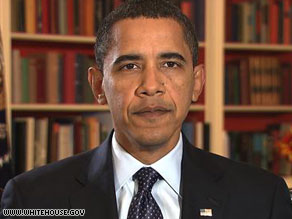
President Obama delivers his weekly radio and Internet address, which focused on the economy.

President Obama delivers his weekly radio and Internet address, which focused on the economy.

"We begin this year and this administration in the midst of an unprecedented crisis that calls for unprecedented action," he said in his weekly radio and Internet address.

"Just this week, we saw more people file for unemployment than at any time in the last 26 years, and experts agree that if nothing is done, the unemployment rate could reach double digits," Obama said.

The president pleaded for urgent action, saying, "If we do not act boldly and swiftly, a bad situation could become dramatically worse."

Obama's remarks came as he is lobbying for quick congressional passage of an $825 billion stimulus package to pump up the economy.

The president revealed more details of his stimulus package, which he said would add more than 3,000 miles of electric lines to transport alternative energy across the country.

Obama also said the plan would save taxpayers $2 billion by making three-quarters of federal buildings more energy efficient and would "save the average working family $350 on their energy bills by weatherizing 2.5 million homes."

The White House also released a report on the "American Recovery and Reinvestment Plan," which calls for greater investment in Pell Grants for college students, a $2,500 college tax credit for 4 million college students and the tripling of the number of fellowships in science to help spur innovation.

Friday, January 23, 2009

Obama asks lawmakers to back stimulus bill

President Barack Obama and congressional Democrats sought to ease Republican complaints about a massive economic stimulus plan Friday, meeting with GOP leaders in the White House and promising to consider some of their recommendations.

Many Republican lawmakers say the $825 billion package is too costly, and that too much of the spending is for long-range projects that won't aid the economy quickly. Some economists say the package should be even bigger, however, and it was unclear whether Republicans would have much impact.

House and Senate GOP leaders "had some constructive suggestions, which we'll review," House Speaker Nancy Pelosi, D-Calif., told reporters after the meeting with Obama and House and Senate leaders from both parties in the Roosevelt Room.

Speaking at the National Press Club shortly after the White House gathering, Sen. Mitch McConnell of Kentucky, the Republican leader in the Senate, said he believes the measure will clear Congress by the mid-February target date set by Obama and Democratic leaders.

In brief remarks before the meeting, Obama urged bipartisan support for the package, adding that he wanted to hear the Republicans' concerns.

"I know that it is a heavy lift to do something as substantial as we're doing right now," Obama said. "I recognize that there are still some differences around the table and between the administration and members of Congress about particular details on the plan.

"But I think what unifies this group is a recognition that we are experiencing an unprecedented, perhaps, economic crisis that has to be dealt with, and dealt with rapidly."

He thanked congressional leaders for working quickly on the rescue package that he says will create 3 million to 4 million new jobs.

"That is going to be absolutely critical and it appears that we are on target to make our President's Day weekend," he said. President's Day falls on Monday, Feb. 16.

Obama also said that any legislation governing the use of an additional $350 billion in financial industry bailout money must include new measures to ensure accountability and transparency.

After the meeting, House Republican Leader John Boehner said he and his colleagues told Obama they feel the stimulus package is too expensive and too slow. He said Republicans told Obama of their own plans to "get fast-acting tax relief in the hands of American families and small businesses, because, at the end of the day, government can't solve this problem."

Republicans have been seeking deeper tax cuts and have said there was no reliable estimate of the bill's impact on employment.

Democrats tried to mitigate the impact of a Congressional Budget Office study that questioned administration claims that the money could be spent fast enough to reduce joblessness quickly.

After attending the White House meeting, Senate Majority Leader Harry Reid, D-Nev., said there was "significant discussion about the CBO numbers." He said Obama's budget director, Peter Orszag, who recently headed the CBO, told participants that the study analyzed only 40 percent of the pending stimulus bill and that Orszag "would guarantee that at least 75 percent of the bill would go directly into the economy within the first 18 months."

Also on Friday, Senate Finance Committee Chairman Max Baucus unveiled a Senate version of the tax-cutting portion of the bill. Social Security recipients would get a bonus payment of $300 under the plan. Its tax cuts and spending proposals total $355 billion. It will be paired with $400 billion in further spending proposed by the Appropriations Committee on the Senate floor.

The House version of the bill advanced in committees this week. Republicans, who are in the minority, were unable to make inroads with their proposals.

The House Ways and Means Committee on Thursday approved $275 billion in tax cuts on a party-line vote of 24-13. The House Energy and Commerce Committee, also working on the bill, cleared $2.8 billion to expand broadband communications service. And on Wednesday night, the House Appropriations Committee approved a $358 billion spending measure on a 35-22 party-line vote.

Obama is scheduled to meet in the Capitol with House Republicans next week, at their request. But by then the House bill could be on the floor awaiting a vote.

Government reports showed the number of new jobless claims was up and new home construction hit an all-time low in December.

Obama reverses Bush abortion-funds policy

President Barack Obama on Friday struck down the Bush administration's ban on giving federal money to international groups that perform abortions or provide abortion information — an inflammatory policy that has bounced in and out of law for the past quarter-century.

Obama's move, the latest in an aggressive first week reversing contentious Bush policies, was warmly welcomed by liberal groups and denounced by abortion rights foes.

The ban has been a political football between Democratic and Republican administrations since GOP President Ronald Reagan first adopted it 1984. Democrat Bill Clinton ended the ban in 1993, but Republican George W. Bush re-instituted it in 2001 as one of his first acts in office.

"For too long, international family planning assistance has been used as a political wedge issue, the subject of a back and forth debate that has served only to divide us," Obama said in a statement released by the White House. "I have no desire to continue this stale and fruitless debate."

He said the ban was unnecessarily broad and undermined family planning in developing countries.

"In the coming weeks, my administration will initiate a fresh conversation on family planning, working to find areas of common ground to best meet the needs of women and families at home and around the world," the president said.

Obama issued the presidential memorandum rescinding the Bush policy without coverage by the media, late Friday afternoon. The abortion measure is a highly emotional one for many people, and the quiet signing was in contrast to the televised coverage of Obama's announcement Wednesday on ethics rules and Thursday's signing of orders on closing the Guantanamo Bay prison camp and banning torture in the questioning of terror suspects.

His action came one day after the 36th anniversary of the landmark Supreme Court ruling in Roe v. Wade that legalized abortion.

The Bush policy had banned U.S. taxpayer money, usually in the form of Agency for International Development funds, from going to international family planning groups that either offer abortions or provide information, counseling or referrals about abortion as a family planning method.

Critics have long held that the rule unfairly discriminates against the world's poor by denying U.S. aid to groups that may be involved in abortion but also work on other aspects of reproductive health care and HIV/AIDS, leading to the closure of free and low-cost rural clinics.

Supporters of the ban say that the United States still provides millions of dollars in family planning assistance around the world and that the rule prevents anti-abortion taxpayers from backing something they believe is morally wrong.

The ban has been known as the "Mexico City policy" for the city a U.S. delegation first announced it at a U.N. International Conference on Population.

Both Obama and Secretary of State Hillary Rodham Clinton, who will oversee foreign aid, had promised to do away with the rule during the presidential campaign.

Clinton said Friday evening that for seven years Bush's policy made it more difficult for women around the world to gain access to essential information and health care services. "Rather than limiting women's ability to receive reproductive health services, we should be supporting programs that help women and their partners make decisions to ensure their health and the health of their families," Clinton said.

In a related move, Obama also said he would restore funding to the U.N. Population Fund (UNFPA). Both he and Clinton had pledged to reverse a Bush administration determination that assistance to the organization violated U.S. law known as the Kemp-Kasten amendment.

Obama, in his statement, said he looked forward to working with Congress to fulfill that promise: "By resuming funding to UNFPA, the U.S. will be joining 180 other donor nations working collaboratively to reduce poverty, improve the health of women and children, prevent HIV/AIDS and provide family planning assistance to women in 154 countries."

Thoraya Ahmed Obaid, executive director of the U.N. Population Fund, said: "The president's actions send a strong message about his leadership and his desire to support causes that will promote peace and dignity, equality for women and girls and economic development in the poorest regions of the world."

"We are confident that under the new president's direction, the U.S. will resume its leadership in promoting and protecting women's reproductive health and rights worldwide," Obaid said in a statement issued at U.N. headquarters in New York.

The Bush administration had barred U.S. money from the fund, contending that its work in China supported a Chinese family planning policy of coercive abortion and involuntary sterilization. UNFPA has vehemently denied that it does.

Congress had appropriated $40 million to the UNFPA in the past budget year, but the administration had withheld the money as it had done every year since 2002.

Organizations and lawmakers that had pressed Obama to rescind the Mexico City policy were jubilant.

House Speaker Nancy Pelosi, D-Calif., said the move "will help save lives and empower the poorest women and families to improve their quality of life and their future."

"Today's announcement is a very powerful signal to our neighbors around the world that the United States is once again back in the business of good public policy and ideology no longer blunts our ability to save lives around the globe," said Sen. John Kerry, D-Mass., chairman of the Senate Foreign Relations Committee.

Population Action International, an advocacy group, said that the policy had "severely impacted" women's health and that the step "will help reduce the number of unintended pregnancies, abortions and women dying from high-risk pregnancies because they don't have access to family planning."

Anti-abortion groups and lawmakers condemned Obama's decision.

"I have long supported the Mexico City Policy and believe this administration's decision to be counter to our nation's interests," said Senate Republican leader Mitch McConnell of Kentucky.

"Coming just one day after the 36th anniversary of the tragic Roe v. Wade decision, this presidential directive forces taxpayers to subsidize abortions overseas — something no American should be required by government to do," said House Minority Leader John Boehner, R-Ohio.

Rep. Mike Pence, R-Ind., called it "morally wrong to take the taxpayer dollars of millions of pro-life Americans to promote abortion around the world."

"President Obama not long ago told the American people that he would support policies to reduce abortions, but today he is effectively guaranteeing more abortions by funding groups that promote abortion as a method of population control," said Douglas Johnson, legislative director of the National Right to Life Committee.

Thursday, January 22, 2009

Obama Names George Mitchell named special envoy for the Middle East

Former Senate Majority Leader George Mitchell was named special envoy for the Middle East during an event at the State Department on Thursday afternoon.

The move could signal that Obama plans to get involved in the Mideast peace process early in his term. It was announced just before 3 p.m. at an event with President Obama and Secretary of State Hillary Clinton.

Also Thursday, former U.N. Ambassador Richard Holbrooke was named special representative for Afghanistan and Pakistan, Secretary of State Hillary Clinton announced.

Holbrooke, who worked as a diplomat, journalist and investment banker, became one of the most influential diplomats in U.S. history when he worked in the mid-90s to end the brutal fighting in the Balkans.

He was the main architect of the Dayton Accords that ended the fighting in Bosnia and Herzegovina.

After he was officially named Obama's envoy, Mitchell said, "I don't underestimate the difficulty of this assignment."

"The situation in the Middle East is volatile, complex and dangerous. But the president and the secretary of state have made it clear that danger and difficulty cannot cause the United States to turn away," he said

Mitchell said that along with Obama and Clinton, he believed a goal of a Jewish state and a Palestinian state living side by side was possible and the conflict, even if centuries old, could end -- a lesson, he said, he learned during his negotiations in Northern Ireland.

"From my experience there, I formed the conviction that there is no such thing as a conflict that can't be ended," Mitchell said. "Conflicts are created, conducted and sustained by human beings. They can be ended by human beings."

In recent days, Obama officials talked to Israeli, Palestinian and Arab diplomats about the choice, sources close to the administration and diplomats told CNN.

After Mitchell was introduced Thursday, Obama said, "Time and again, in public service and private life, he has acted with skill and acted with integrity. He will be fully empowered at the negotiating table, and he will sustain our focus on the goal of peace. "

Mitchell served as a Mideast envoy for the Bush administration, writing a 2001 report that called for a halt to Israeli settlements and greater Palestinian efforts to crack down on terror.

He also was a peace broker on Northern Ireland for President Clinton.

Sallai Meridor, Israel's ambassador to the United States, released a statement Thursday saying, "Israel holds Sen. Mitchell in high regard and looks forward to working with him on taking the next steps towards realizing a future of peace and security for Israel and her neighbors."

Meridor also said Holbrooke was a "longstanding friend of Israel and we wish him every success."

Holbrooke called his mission "a very difficult assignment."

"Nobody can say the war in Afghanistan has gone well, and yet, as we speak here today, American men and women and their coalition partners are fighting a very difficult struggle against a ruthless and determined enemy without any scruples at all," he said after his appointment was announced.

But Holbrooke said, "If our resources are mobilized and coordinated and pulled together, we can quadruple, quintuple, multiply by tenfold the effectiveness of our efforts there."

Mitchell and Holbrooke are two of several envoys who will work in the new administration. Sources say Dennis Ross, a former Mideast peace envoy for several previous administrations, will be an envoy in charge of engaging Iran, but it's unclear what role he'll play in light of Mitchell's appointment

Obama signs order to close Guantanamo Bay facility

Promising to return America to the "moral high ground" in the war on terrorism, President Obama issued three executive orders Thursday to demonstrate a clean break from the Bush administration, including one requiring that the Guantanamo Bay detention facility be closed within a year.

During a signing ceremony at the White House, Obama reaffirmed his inauguration pledge that the United States does not have "to continue with a false choice between our safety and our ideals."

The president said he was issuing the order to close the facility in order to "restore the standards of due process and the core constitutional values that have made this country great even in the midst of war, even in dealing with terrorism."

A second executive order formally bans torture by requiring that the Army field manual be used as the guide for terrorism interrogations. That essentially ends the Bush administration's CIA program of enhanced interrogation methods.

"We believe that the Army field manual reflects the best judgment of our military, that we can abide by a rule that says we don't torture, but that we can still effectively obtain the intelligence that we need," Obama said

"This is me following through ... on an understanding that dates back to our founding fathers, that we are willing to observe core standards of conduct not just when it's easy but also when it's hard."

A third executive order establishes an interagency task force to lead a systematic review of detention policies and procedures and a review of all individual cases.

The task force, Obama stated, will also "provide me with information in terms of how we are able to deal [with] the disposition of some of the detainees that may be currently in Guantanamo that we cannot transfer to other countries, who could pose a serious danger to the United States."

The president also signed a memorandum requesting a delay in the Supreme Court's hearing of the case of Ali Saleh Kahlah al-Marri, a legal U.S. resident contesting his detention for more than five years as an enemy combatant. He has been held in a military brig without the government bringing any charges against him.

Al-Marri's case is scheduled to be heard by the high court in March or April.

Al-Marri "is clearly a dangerous individual," Obama said. "We have asked for a delay in going before the Supreme Court to properly review the evidence against him."

During the second Bush term, the detention facility at Guantanamo Bay became a lightning rod for critics who charged the Bush administration with torturing terrorist suspects. President George W. Bush and other senior officials repeatedly denied that the U.S. government had used torture to extract intelligence from terror suspects.

The decision to close the detention facility received immediate backing from Obama's general election opponent, Arizona Republican Sen. John McCain.

McCain, in a joint statement with South Carolina GOP Sen. Lindsey Graham, said he supported Obama's decision to "reaffirm America's adherence to the Geneva Conventions, and begin a process that will, we hope, lead to the resolution of all cases of Guantanamo detainees."

Thursday night on CNN's "Larry King Live," McCain said he thinks the new president may have been hasty in the decision and should have taken the time to consider everything associated with closing the camp before forcing himself into a timetable.

Specifically, McCain said he thought Obama needed to consider what would happen to the prisoners held at Guantanamo before ordering the facility to be closed.

"So, the easy part, in all due respect, is to say we're going to close Guantanamo," McCain said. "Then I think I would have said where they were going to be taken. Because you're going to run into a NIMBY [not in my backyard] problem here in the United States of America."

A number of congressional Republicans criticized Obama's decision.

"We cannot risk going back to the politically correct national security policies that left us vulnerable in the lead-up to 9/11," Michigan GOP Rep. Peter Hoekstra, a member of the House Intelligence Committee, said in a written statement. "Without a clear plan for the detention and interrogation of captured terrorists and combatants, we are unnecessarily risking the safety of our nation."

Rep. John Murtha, D-Pennsylvania, an outspoken critic of the Bush administration, praised the action, calling it "a first key step in restoring America's image and credibility in the world."

"The Bush administration never understood what the Guantanamo detention facility symbolized to the rest of the world," Murtha said in a written statement. "They saw it as simply a prison. ... The problem with Guantanamo was never about its bricks and mortar. The problem with Guantanamo is that its very existence stains and defies the moral fiber of our great nation."

Obama's move highlights a fierce struggle over where the prison's detainees will go next.

Asked about that issue Thursday, Defense Secretary Robert Gates said, "We have developed some options in terms of how many we think could be returned to other countries to take them. That diplomatic initiative has not started. That will await work in carrying out the executive order."

"We have identified a number of possible prisons here in the United States" that could take the detainees. However, Gates added, "I've heard from members of Congress [representing] where all those prisons are located. Their enthusiasm is limited.

Rep. Bill Young, R-Florida, said he has "quite a bit of anxiety" about the possibility of transferring detainees to U.S. facilities.

"Number one, they're dangerous," Young said. "Secondly, once they become present in the United States, what is their legal status? What is their constitutional status? I worry about that, because I don't want them to have the same constitutional rights that you and I have. They're our enemy.

Wednesday, January 21, 2009

Obama Steps into Oval Office

President Barack Obama stepped into the Oval Office for the first time as chief executive on Wednesday and summoned economic advisers and top military officials to meetings aimed at delivering the change he promised as a candidate. Aides circulated a draft executive order to close the detention center at Guantanamo Bay.

The president also placed phone calls to Israeli, Palestinian, Egyptian and Jordanian leaders.

Obama emphasized in the conversations that he would work to consolidate the cease-fire between Israel and Hamas in Gaza, said the new White House press secretary, Robert Gibbs.

Gibbs said Obama expressed "his commitment to active engagement in pursuit of Arab-Israeli peace from the beginning of his term."

A multi-denominational prayer service at Washington National Cathedral and an open house at the presidential mansion were also on the schedule of the 44th president, taking office on a promise to fix the battered economy and withdraw U.S. troops from the unpopular war in Iraq on a 16-month timetable.

Tuesday, January 20, 2009

Obama's inaugural speech

Barack Obama was sworn in as the 44th president of the United States and the nation's first African-American president Tuesday. This is a transcript of his prepared speech.

My fellow citizens:

I stand here today humbled by the task before us, grateful for the trust you have bestowed, mindful of the sacrifices borne by our ancestors. I thank President Bush for his service to our nation, as well as the generosity and cooperation he has shown throughout this transition.

Forty-four Americans have now taken the presidential oath. The words have been spoken during rising tides of prosperity and the still waters of peace. Yet, every so often, the oath is taken amidst gathering clouds and raging storms. At these moments, America has carried on not simply because of the skill or vision of those in high office, but because We the People have remained faithful to the ideals of our forebearers, and true to our founding documents.

So it has been. So it must be with this generation of Americans.

That we are in the midst of crisis is now well understood. Our nation is at war, against a far-reaching network of violence and hatred. Our economy is badly weakened, a consequence of greed and irresponsibility on the part of some, but also our collective failure to make hard choices and prepare the nation for a new age. Homes have been lost; jobs shed; businesses shuttered. Our health care is too costly; our schools fail too many; and each day brings further evidence that the ways we use energy strengthen our adversaries and threaten our planet.

These are the indicators of crisis, subject to data and statistics. Less measurable but no less profound is a sapping of confidence across our land -- a nagging fear that America's decline is inevitable, and that the next generation must lower its sights.

Today I say to you that the challenges we face are real. They are serious and they are many. They will not be met easily or in a short span of time. But know this, America: They will be met.

On this day, we gather because we have chosen hope over fear, unity of purpose over conflict and discord.

On this day, we come to proclaim an end to the petty grievances and false promises, the recriminations and worn-out dogmas, that for far too long have strangled our politics.

We remain a young nation, but in the words of Scripture, the time has come to set aside childish things. The time has come to reaffirm our enduring spirit; to choose our better history; to carry forward that precious gift, that noble idea, passed on from generation to generation: the God-given promise that all are equal, all are free, and all deserve a chance to pursue their full measure of happiness.

In reaffirming the greatness of our nation, we understand that greatness is never a given. It must be earned. Our journey has never been one of shortcuts or settling for less. It has not been the path for the fainthearted -- for those who prefer leisure over work, or seek only the pleasures of riches and fame. Rather, it has been the risk-takers, the doers, the makers of things -- some celebrated, but more often men and women obscure in their labor -- who have carried us up the long, rugged path toward prosperity and freedom.

For us, they packed up their few worldly possessions and traveled across oceans in search of a new life.

For us, they toiled in sweatshops and settled the West; endured the lash of the whip and plowed the hard earth.

For us, they fought and died, in places like Concord and Gettysburg; Normandy and Khe Sahn.

Time and again, these men and women struggled and sacrificed and worked till their hands were raw so that we might live a better life. They saw America as bigger than the sum of our individual ambitions; greater than all the differences of birth or wealth or faction.

This is the journey we continue today. We remain the most prosperous, powerful nation on Earth. Our workers are no less productive than when this crisis began. Our minds are no less inventive, our goods and services no less needed than they were last week or last month or last year. Our capacity remains undiminished. But our time of standing pat, of protecting narrow interests and putting off unpleasant decisions -- that time has surely passed. Starting today, we must pick ourselves up, dust ourselves off, and begin again the work of remaking America.

For everywhere we look, there is work to be done. The state of the economy calls for action, bold and swift, and we will act -- not only to create new jobs, but to lay a new foundation for growth. We will build the roads and bridges, the electric grids and digital lines that feed our commerce and bind us together. We will restore science to its rightful place, and wield technology's wonders to raise health care's quality and lower its cost. We will harness the sun and the winds and the soil to fuel our cars and run our factories. And we will transform our schools and colleges and universities to meet the demands of a new age. All this we can do. And all this we will do.

Now, there are some who question the scale of our ambitions -- who suggest that our system cannot tolerate too many big plans. Their memories are short. For they have forgotten what this country has already done; what free men and women can achieve when imagination is joined to common purpose, and necessity to courage.

What the cynics fail to understand is that the ground has shifted beneath them -- that the stale political arguments that have consumed us for so long no longer apply. The question we ask today is not whether our government is too big or too small, but whether it works -- whether it helps families find jobs at a decent wage, care they can afford, a retirement that is dignified. Where the answer is yes, we intend to move forward. Where the answer is no, programs will end. And those of us who manage the public's dollars will be held to account -- to spend wisely, reform bad habits, and do our business in the light of day -- because only then can we restore the vital trust between a people and their government.

Nor is the question before us whether the market is a force for good or ill. Its power to generate wealth and expand freedom is unmatched, but this crisis has reminded us that without a watchful eye, the market can spin out of control -- and that a nation cannot prosper long when it favors only the prosperous. The success of our economy has always depended not just on the size of our gross domestic product, but on the reach of our prosperity; on our ability to extend opportunity to every willing heart -- not out of charity, but because it is the surest route to our common good.

As for our common defense, we reject as false the choice between our safety and our ideals. Our Founding Fathers, faced with perils we can scarcely imagine, drafted a charter to assure the rule of law and the rights of man, a charter expanded by the blood of generations. Those ideals still light the world, and we will not give them up for expedience's sake. And so to all other peoples and governments who are watching today, from the grandest capitals to the small village where my father was born: Know that America is a friend of each nation and every man, woman and child who seeks a future of peace and dignity, and that we are ready to lead once more.

Recall that earlier generations faced down fascism and communism not just with missiles and tanks, but with sturdy alliances and enduring convictions. They understood that our power alone cannot protect us, nor does it entitle us to do as we please. Instead, they knew that our power grows through its prudent use; our security emanates from the justness of our cause, the force of our example, the tempering qualities of humility and restraint.

We are the keepers of this legacy. Guided by these principles once more, we can meet those new threats that demand even greater effort -- even greater cooperation and understanding between nations. We will begin to responsibly leave Iraq to its people, and forge a hard-earned peace in Afghanistan. With old friends and former foes, we will work tirelessly to lessen the nuclear threat, and roll back the specter of a warming planet. We will not apologize for our way of life, nor will we waver in its defense, and for those who seek to advance their aims by inducing terror and slaughtering innocents, we say to you now that our spirit is stronger and cannot be broken; you cannot outlast us, and we will defeat you.

For we know that our patchwork heritage is a strength, not a weakness. We are a nation of Christians and Muslims, Jews and Hindus -- and nonbelievers. We are shaped by every language and culture, drawn from every end of this Earth; and because we have tasted the bitter swill of civil war and segregation, and emerged from that dark chapter stronger and more united, we cannot help but believe that the old hatreds shall someday pass; that the lines of tribe shall soon dissolve; that as the world grows smaller, our common humanity shall reveal itself; and that America must play its role in ushering in a new era of peace.

To the Muslim world, we seek a new way forward, based on mutual interest and mutual respect. To those leaders around the globe who seek to sow conflict, or blame their society's ills on the West: Know that your people will judge you on what you can build, not what you destroy. To those who cling to power through corruption and deceit and the silencing of dissent, know that you are on the wrong side of history; but that we will extend a hand if you are willing to unclench your fist.

To the people of poor nations, we pledge to work alongside you to make your farms flourish and let clean waters flow; to nourish starved bodies and feed hungry minds. And to those nations like ours that enjoy relative plenty, we say we can no longer afford indifference to suffering outside our borders; nor can we consume the world's resources without regard to effect. For the world has changed, and we must change with it.

As we consider the road that unfolds before us, we remember with humble gratitude those brave Americans who, at this very hour, patrol far-off deserts and distant mountains. They have something to tell us today, just as the fallen heroes who lie in Arlington whisper through the ages. We honor them not only because they are guardians of our liberty, but because they embody the spirit of service; a willingness to find meaning in something greater than themselves. And yet, at this moment -- a moment that will define a generation -- it is precisely this spirit that must inhabit us all.

For as much as government can do and must do, it is ultimately the faith and determination of the American people upon which this nation relies. It is the kindness to take in a stranger when the levees break, the selflessness of workers who would rather cut their hours than see a friend lose their job which sees us through our darkest hours. It is the firefighter's courage to storm a stairway filled with smoke, but also a parent's willingness to nurture a child, that finally decides our fate.

Our challenges may be new. The instruments with which we meet them may be new. But those values upon which our success depends -- hard work and honesty, courage and fair play, tolerance and curiosity, loyalty and patriotism -- these things are old. These things are true. They have been the quiet force of progress throughout our history. What is demanded then is a return to these truths. What is required of us now is a new era of responsibility -- a recognition, on the part of every American, that we have duties to ourselves, our nation and the world; duties that we do not grudgingly accept but rather seize gladly, firm in the knowledge that there is nothing so satisfying to the spirit, so defining of our character, than giving our all to a difficult task.

This is the price and the promise of citizenship.

This is the source of our confidence -- the knowledge that God calls on us to shape an uncertain destiny.

This is the meaning of our liberty and our creed -- why men and women and children of every race and every faith can join in celebration across this magnificent Mall, and why a man whose father less than 60 years ago might not have been served at a local restaurant can now stand before you to take a most sacred oath.

So let us mark this day with remembrance, of who we are and how far we have traveled. In the year of America's birth, in the coldest of months, a small band of patriots huddled by dying campfires on the shores of an icy river. The capital was abandoned. The enemy was advancing. The snow was stained with blood. At a moment when the outcome of our revolution was most in doubt, the father of our nation ordered these words be read to the people:

"Let it be told to the future world ... that in the depth of winter, when nothing but hope and virtue could survive... that the city and the country, alarmed at one common danger, came forth to meet [it]."

America. In the face of our common dangers, in this winter of our hardship, let us remember these timeless words. With hope and virtue, let us brave once more the icy currents, and endure what storms may come. Let it be said by our children's children that when we were tested, we refused to let this journey end, that we did not turn back, nor did we falter; and with eyes fixed on the horizon and God's grace upon us, we carried forth that great gift of freedom and delivered it safely to future generations.

Obama becomes 44th President

Barack Obama delivered a sobering assessment of where America stands and a hopeful vision of what it can become as he gave his inaugural address as the nation's 44th president.

"Today I say to you that the challenges we face are real. They are serious and they are many. They will not be met easily or in a short span of time," Obama told those gathered on the National Mall in front of the Capitol.

"But know this, America -- they will be met," he said.

He also vowed to end the divisiveness and partisanship he said was rampant through Washington.

"We come to proclaim an end to the petty grievances and false promises, the recriminations and worn-out dogmas that for far too long have strangled our politics," he said.

In another allusion to Washington's shortcomings, Obama promised to hold accountable anyone who handles taxpayer dollars.

"And those of us who manage the public's dollars will be held to account -- to spend wisely, reform bad habits, and do our business in the light of day -- because only then can we restore the vital trust between a people and their government."

The new president, who hugged civil rights stalwart Rep. John Lewis, D-Georgia, on the inaugural stage Tuesday, also hailed the civil rights movement.

"This is the meaning of [America's] liberty and our creed -- why men and women and children of every race and every faith can join in celebration across this magnificent mall, and why a man whose father, less than 60 years ago, might not have been served at a local restaurant can now stand before you to take a most sacred oath," Obama said.

The address touched on other themes, including a warning to terrorists.

"With old friends and former foes, we will work tirelessly to lessen the nuclear threat, and roll back the specter of a warming planet. We will not apologize for our way of life, nor will we waver in its defense, and for those who seek to advance their aims by inducing terror and slaughtering innocents, we say to you now that our spirit is stronger and cannot be broken; you cannot outlast us, and we will defeat you," the president stated.

After the speech, spectator L.J. Caldwell said the moment represented the pinnacle thus far in the civil rights movement.

"When you think back, Malcolm [X] fought. Then we come a little further, Rosa Parks sat. Then come up a little further and [the Rev. Martin Luther King Jr.] spoke. Then today, President Obama ran and we won," said Caldwell, of Somerset, New Jersey.

Wearing a navy suit and red tie, Obama was sworn in using the same Bible that was used in President Abraham Lincoln's inauguration.

The jubilant crowd became quiet as Obama began his address, with only an occasional "That's right" or "Amen" and scattered applause from the hundreds of thousands in front of him.

Saddleback Church founder Rick Warren delivered the invocation, applauding what he called "a hinge-point in history." Civil rights veteran the Rev. Joseph Lowery gave the benediction.

Aretha Franklin sang "My Country 'Tis of Thee" before Joe Biden was sworn in as vice president.

Following the inauguration ceremony, Obama walked into the Capitol and signed his Cabinet nominations -- which the Senate will vote on when it convenes at 3 p.m. -- and signed a proclamation of national renewal and reconciliation.

"I was told not to swipe the pen," Obama quipped after signing the document, similar to proclamations signed by the last three presidents.

Hundreds of thousands of people gathered on the National Mall -- dancing, singing and vigorously shaking flags -- before Tuesday's swearing-in.

"This is America happening," said Evadey Minott of Brooklyn, New York. "It was prophesized by King that we would have a day when everyone would come together. This is that day. I am excited. I am joyful. It brings tears to my eyes."

Minott was at Lafayette Square near the White House, where Obama and his wife, Michelle, had coffee with President Bush and first lady Laura Bush before heading to Capitol Hill.

The Obamas attended a prayer service earlier at St. John's Episcopal Church to kick off the day of events surrounding Obama's inauguration.

As many as 2 million people were expected to crowd into the area between the Capitol, the White House and the Lincoln Memorial.

Gerrard Coles of Norwalk, Connecticut, had staked out a position in front of St. John's.

"Everyone's down here -- hopefully to catch a glimpse of Barack, just for a split second," he said. "I think this was a beautiful thing. It's something I always wanted to do. It's not every day that you get to be a part of history. Rather than just watch it on TV, you actually get to partake in it and you have a story to tell your kids."

Nine-year-old Laura Bruggerman also hoped to catch a glimpse of the soon-to-be president. She waited with her mother, Wendy, and father, Jeff, of Bethesda, Maryland, amid an affable crowd that tried to let shorter onlookers and children to the front for better views.

"I want to see Obama. I think that would be really cool. I could tell all of my friends that I got to see him," the youngster said.

Some spectators were more than a mile from the swearing-in ceremony, watching on giant TV screens erected along the National Mall.

The historic event has drawn myriad celebrities and politicians, including actors Dustin Hoffman and Denzel Washington, director Steven Spielberg and former vice presidents Dan Quayle, Al Gore and Walter Mondale.

Former Presidents Clinton, Carter and George H.W. Bush also were in attendance. Clinton and Bush shared an embrace

Oprah Winfrey and actor Samuel L. Jackson sat on the same row. Winfrey hugged Senate hopeful Caroline Kennedy and later said of the inauguration, "It's behind the dream. We're just here feeling it with the throngs of people. It's amazing grace personified."

After a formal farewell to President Bush and lunch with congressional leaders, Obama will head up Pennsylvania Avenue to the White House, where he and his family will watch the inauguration parade from a reviewing stand. The parade begins at 3:45 p.m. ET

The new president and first lady will close the night by attending 10 official inaugural balls.

In addition to Secret Service, the security effort will involve 8,000 police officers from the District of Columbia and other jurisdictions, 10,000 National Guard troops, about 1,000 FBI personnel, and hundreds of others from the Department of Homeland Security, the National Park Service and U.S. Capitol Police.

Change comes to Washington

Former presidents, lawmakers, dignitaries and an estimated 2 million average citizens huddled in freezing weather on Capitol Hill to watch Barack Obama take the oath as the nation's first black president. "I stand here today humbled by the task before us, grateful for the trust you have bestowed, mindful of the sacrifices borne by our ancestors," Obama said in his inaugural address. Moments later, former President Bush and Laura Bush left to fly home to Texas.